Everyone is an artist
This summer I returned to Turning Earth after a long sabbatical spentlooking after young children and reconnecting with my own artisticpractice. My co-workers have been asking me about the founding visionof our studios. I’ve been thinking about it a lot.
I woke up this morning, on the Autumn equinox, also knownastrologically as ‘The Cusp of Beauty’, with this sentenceringing in my mind: “Everyone is an artist.”
Turning Earth runs ceramic studios where people can come and makeceramics, but our core purpose is really to create a broad adultcurriculum — a way of reclaiming creativity, making and beauty asordinary parts of adult life.
When children are growing up, we consider them to be rounded peoplewho should try everything. We teach them English, Maths, Science. Wegive them paint and crayons and drive them to music classes. We makethem do PE. We take them to football practice. We recognise that theyare, each one, multifaceted.
Then, as adults, in the highly specialised economy we’ve inherited,we easily become stuck in a very inhuman division of labour. Webecome accountants, lawyers, programmers, and spend most of our time— and build our identities — around one area of expertise.
I think there’s something quite strange about that.
Pottery is interesting in this context because it has also becomemuch more specialised than it once was.
Only a few hundred years ago in these islands, pottery would havebeen practised much more widely. Not by everybody, but there wouldhave been potters in every corner of the land, working in smallcottage industries. Everything they made was relatively low-fired,and the clay could generally be sourced locally.
The kind of stoneware we use today has a much more complex history.In China, ceramics developed into a highly sophisticated industrialprocess very early on. Over a thousand years ago, Chinese potterieshad developed forms of division of labour that allowed them toproduce ware on a large scale and with extraordinary complexity. Theyhad very sophisticated glazes and firing processes.
That history gave us the high-fired stonewares and glazes we nowthink of in the UK as the studio standard. But the sophistication ofthese processes, while making the ware more varied and beautiful, andmore durable, also makes the process much less accessible. Youcouldn’t simply dig clay up from around where you live and makethat kind of pottery. You need specialised materials, specialisedknowledge and specialised equipment.
So what we’re doing at Turning Earth is taking something that hasbecome incredibly complicated and global and making it local andaccessible and possible again.
And I think that matters because to be human is to be artistic, andpottery is our oldest practical art form.
But for me personally, this isn’t just about pottery. It’sbroader than that. It’s about who gets to make things at all, whoart belongs to, and what it is to have a personal relationship withbeauty.
For me, attending a community pottery when I lived in NorthernCalifornia was life-changing. I sat down at a wheel and discoveredthat I could make bowls and plates, and make my rented kitchen comealive with something indescribably my own. It was incrediblyempowering. I realised that I could bring into physical existence avision that had previously lived only in my mind. It changed the wayI thought, and ultimately it led me to become an entrepreneur.
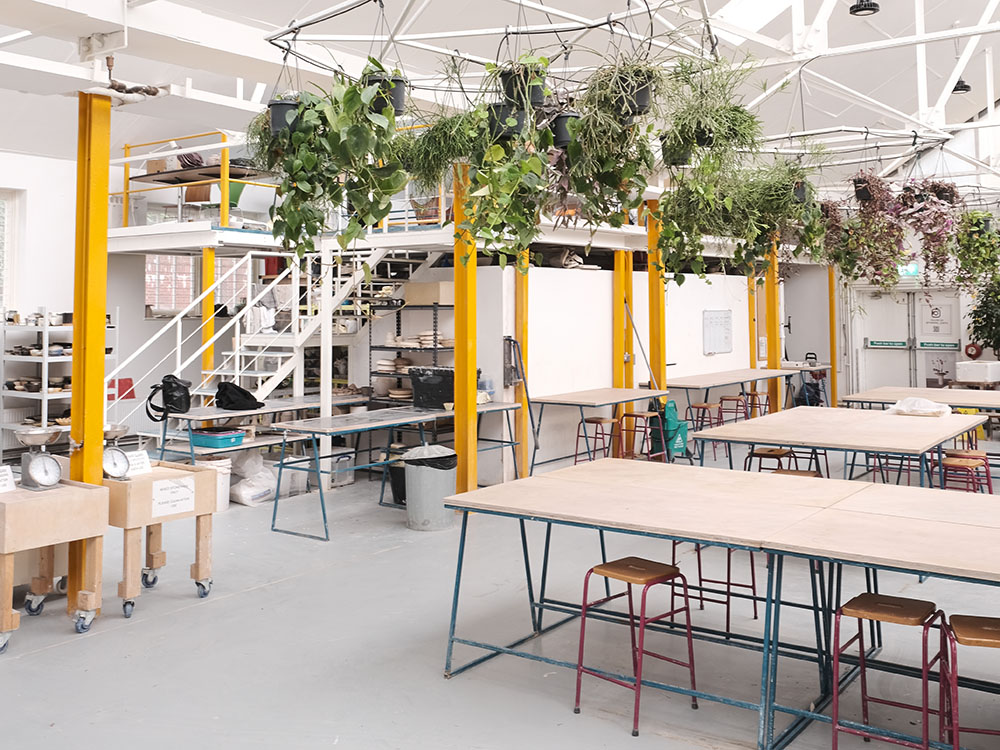
One person might be a potter secretly, in their heart of hearts.Another might express themselves through poetry, which is more my ownmedium these days.. Someone else might enjoy making their environmentbeautiful with well-designed practical items, like the Turning Earthtechnicians who carefully welded the tables in our Highgate studioout of metal.
The main thing is that I believe everyone has creativity and a loveof beauty buried in them in one form or another. The more access wehave to that part of ourselves, the more vibrant we are, and the morehuman we are. When we are creative, we can innovate, change and adaptto the world around us with the inspiration and freedom we oncepossessed as children. We are agents in reality rather than passiveconsumers. Collectively, this is meaningful: the more creative we arethe more capable we are of engaging with the challenges life throwsat us, including the big issues of our time.
For me, it is also a spiritual concern: I believe that the more weexperience ourselves as makers and creators, the less subject we areto the conditioning we inherit, and the closer we can draw to thetruth of what we are.
And I think there’s something about beauty in that too. Culturally,we’ve made beauty something to be produced by specialists foreverybody else to consume. I think we need to reclaim beauty as ahuman value — not simply something to look at, but something wecan participate in making.
Beauty is to be found in the handmade, just as our forebears in theArts and Crafts movement proclaimed. But it is also to be found inthe process of making itself, and the sensitivity it creates in themaker; a way of seeing, a part of being human.
That’s also why what we’re doing isn't really about producingprofessional potters. I’m not interested in an inherited marketlogic that reduces people to economic units — to what we are ableto sell.
Some of our members will become professional potters. Some peoplewill sell their work at markets, simply for fun. Most people willmake only for themselves and their friends. That’s completely fine.
Our users are varied. They might be burned-out executives who needsomething else in their lives, graphic designers who spend their daystransmitting visual ideas through screens and who miss using theirhands, mothers who need time for themselves. Our students might havenever lost their connection to the creativity they had as a child, orhave since built an image of themselves as “not good at that kindof thing.”
Whoever you are, making things with other people, making things foryourself and giving them to your friends, can bring a surprisingamount of satisfaction.
Our hands evolved, from our earliest origins, in relationship withclay: moulding it into pots we could use. There is something deeplyhuman about allowing the physicality of experience to take over. Clayitself is the product of an immense geological and biologicalhistory: the weathered residue of slaked rock, transformed throughinteraction with the biological world over millennia into a highlyplastic, infinitely versatile medium of expression.
I believe it is that physicality, that long evolution in symbiosiswith the natural world, which ultimately distinguishes the humanfrom the technologies and artificial intelligences we have created.
And so that’s what I think Turning Earth is about, finally: givingpeople the opportunity to make things, to discover that they can doit, and to reconnect with the part of themselves that is not justcreative, but a creator.
In this fast-changing, untethered era of history, I want to make thatexperience happen on a broad enough scale to influence our culture. Ibelieve widespread access to making can help us get into deeperrelationship with the material world around us, to find new ways tobe drawn into community, and to remain centred in our humanity.
Tallie, Founder, Turning Earth