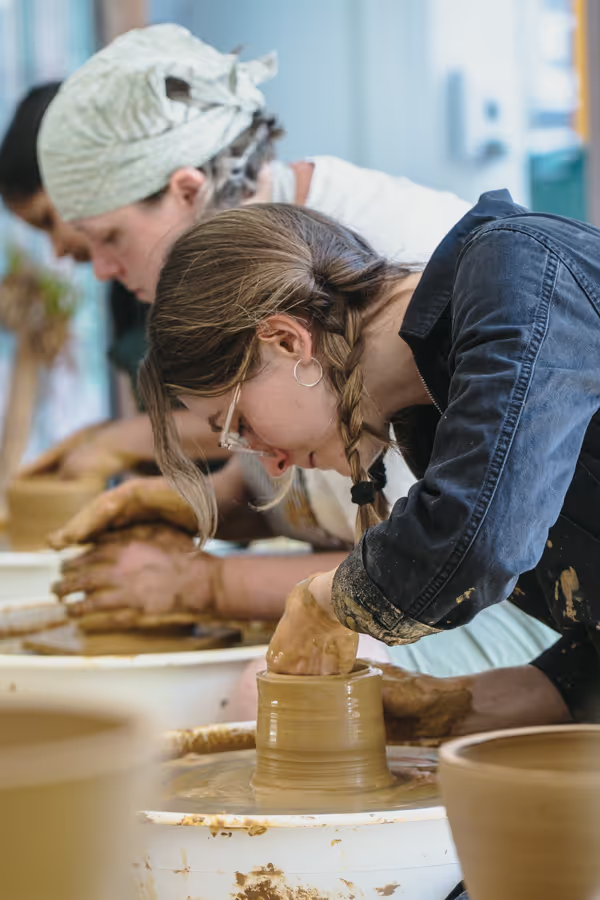
Next start
July 7, 2026
Highgate
·
Available
Our most popular course. Twelve three-hour sessions covering hand-building, wheel throwing, and glazing, with time in the later weeks to develop your own projects.
The 12-week course is the longest of our beginner courses, and our most popular. The extra weeks give you time to learn the core techniques without rushing, get repeated practice on the wheel, and start developing your own work in the later sessions.
You'll work on both the wheel and hand-building, learn to glaze your finished pieces, and have time for personal projects in the later weeks.
The 12-week course is for complete beginners, and for students coming back after a shorter course who want more time on both the wheel and hand-building. You don't need any previous experience.

Surface treatments
Decorative work done before glazing: slip, sgraffito, carving, stamping, or burnishing. These add texture, pattern, or contrast that the glaze then interacts with in the kiln.
Layering
Applying one glaze over another to create a surface different to either glaze alone. The result depends on the chemistry of both glazes and how thickly each is applied.
Advanced glaze application
Glazing methods that go beyond basic dipping. Brushing, pouring, layering, and combining glazes to control where and how the surface develops in the kiln.
Bisque preparation
Getting your pieces ready for their first firing. Final trimming, signing the base, and making sure each piece is bone-dry and crack-free before it goes in the kiln.
Foot rings
The raised ring on the base of a thrown piece. Trimmed from a thicker base once the clay is leather-hard, the foot ring lifts the piece off the surface and gives it a finished underside.
Final trimming
The last pass before bisque firing. Sharpening foot rings, checking wall thickness, and making any last adjustments to the form while the clay is still workable.
Advanced trimming
Trimming complex forms like bottles and vases, where the foot needs to balance a tall or curved body. Done at leather-hard, often with the piece held upside down on a chuck.
Wide-form centring
Centring a larger volume of clay across a wider base than you would for a cylinder or bowl. Harder to feel because the centre of mass sits further from the wheel head.
Throwing batts
Removable wooden or composite discs that fit onto the wheel head. Wide, flat, or fragile forms get thrown on a batt so they can be lifted off without distorting before they've stiffened.
Platters
Larger and lower than plates, with a flat or shallow centre and a defined rim. The wider footprint makes them harder to centre and harder still to lift off the wheel intact.
Plates
One of the hardest forms to throw well. The wider, flatter shape tests your centring and wall control in a different way to cylinders or bowls. Usually thrown on a batt so it can be lifted without warping.
Belly shapes
Forms that swell outward through the middle before tapering at the top. You control the clay's outward curve from the inside, a different challenge to collaring inward.
Bottle shapes
Thrown forms with a narrow neck and wider body. Building one needs control of collaring throughout the throw so the shoulder and neck come out in proportion.
Collaring
Narrowing the opening of a thrown form by squeezing inward as it spins. The technique works against the clay's tendency to widen and is the foundation of bottles, vases, and any enclosed shape.
Glaze introduction
An overview of the glazes we keep in the studio and how to choose ones that suit your work.
Cups
Cups build on the cylinder. Same throwing technique, with extra attention to wall thickness for comfortable handling and a clean rim for drinking.
Wax resist
Applying wax to areas you want to keep glaze-free, creating patterns and contrast between glazed and unglazed surfaces.
Glaze application
Dipping, brushing, and pouring. Each method produces different results. You’ll test on sample tiles before committing to your pieces.
Sgraffito
Scratching through a layer of slip to reveal the clay colour beneath. A simple technique that produces beautiful, graphic results.
Decorating with slips
Coloured liquid clay applied to the surface before firing. You can brush, pour, dip, or trail it for different effects.
Pulling handles
Pulling handles from a lump of clay and attaching them to mugs and jugs. A satisfying skill that takes your thrown work to the next level.
Hump moulds
Using plaster forms to shape consistent pieces. Useful for plates, shallow bowls, and repeatable shapes.
Trimming & turning
Once your thrown pieces have dried slightly, you’ll flip them over on the wheel to refine the shape, add foot rings, and clean up the base.
Bowls
Opening out from a centred lump into wider, shallower forms. Different hand positions and a different feel to cylinders.
Cylinders
The foundation form. Mugs, vases, and tumblers all start as cylinders. You’ll learn to pull walls up evenly and control thickness.
Centring
The essential first step. Getting a lump of clay perfectly steady on a spinning wheel. It takes practice, and your teacher will work with you until it clicks.
Joining & scoring
Scoring, slipping, and assembling separate pieces of clay. The fundamentals of making anything with more than one part.
Slab building
Rolling flat sheets of clay and assembling them into structure. Boxes, planters, angular forms that the wheel can’t produce.
Coiling
Building walls ring by ring for larger forms. You’ll learn to roll consistent coils and join them securely to create pots, vases, and sculptural pieces.
Pinching
The simplest and oldest forming method. You’ll make a small vessel entirely by pinching the clay walls thinner. It teaches you how clay responds to pressure.
Tools & materials
What each tool does and when to reach for it. Ribs, wire cutters, trimming tools, sponges, and more.
Studio safety & etiquette
Dust management, safe use of equipment, kiln protocols, and keeping your workspace clean. We take this seriously because ceramic dust is no joke.
Wedging
Learning to condition clay by hand, pushing, folding, and working it until it’s smooth and free of air bubbles. This is how every session starts.
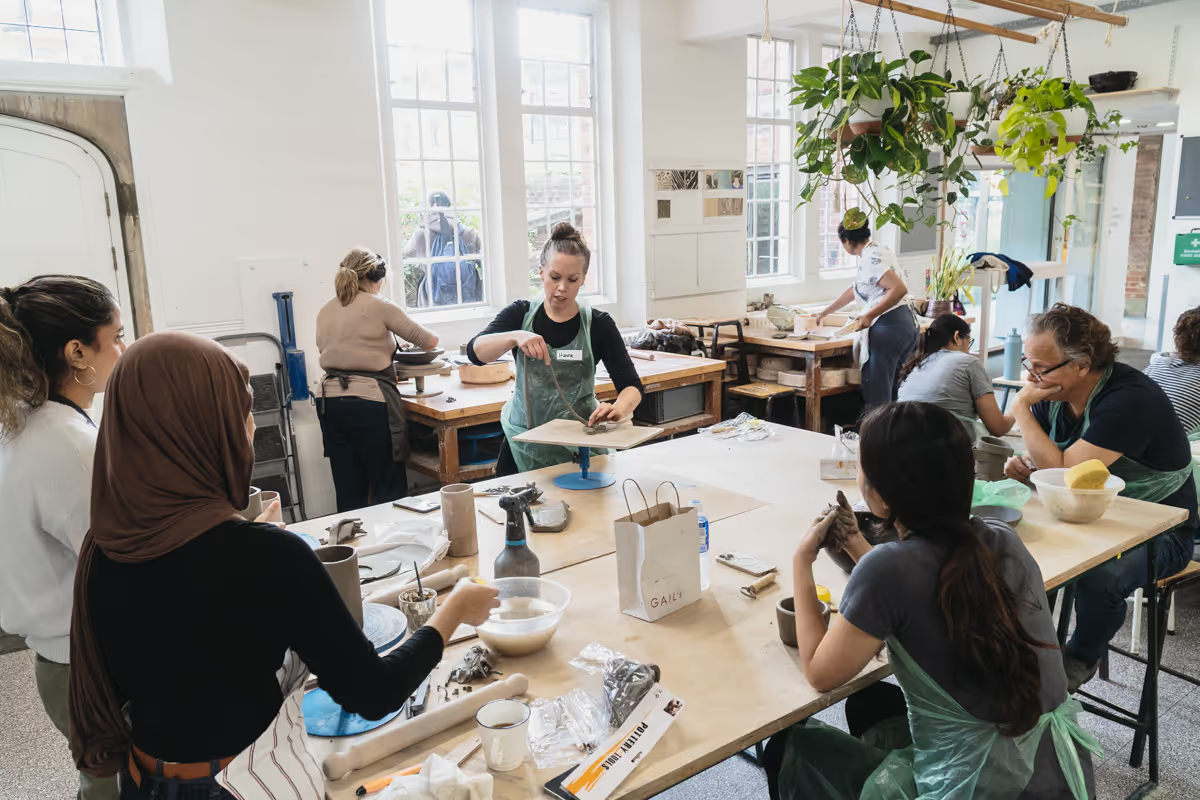
Twelve weeks gives you time to practise new techniques before the next one is introduced, and space in the later weeks for personal projects.
Week 1
+
Your first session is about getting comfortable with the studio, the clay, and the tools you'll use for the next twelve weeks. You'll get an introduction to studio safety, learn how to prepare clay by wedging, and start your first hand-building project using pinching and coiling techniques.
Wedging · Studio safety & etiquette · Tools & materials · Pinching
Weeks 2–3
+
These sessions continue instruction in the three core hand-building methods: pinching, coiling, and slab building. They're the foundation of all ceramic work, and give you a basis for understanding clay as a material before you move onto the wheel.
Pinching · Coiling · Slab building · Joining & scoring
Weeks 4–5
+
This is where the wheel comes in. You'll learn to centre clay, pull up walls, and shape basic forms: cylinders, bowls, and cups. You'll also learn to trim your thrown pieces to refine their shape. Two weeks on the wheel gives time to practise each technique before moving on. If you prefer hand-building, there's also room to keep working on those projects.
Centring · Cylinders · Bowls · Trimming & turning · Hump moulds · Pulling handles
Week 6
+
This session introduces a selection of our studio glazes and covers the practicalities of applying them. You'll also have a chance to glaze any pieces that have come back from the bisque kiln by this point.
Glaze introduction · Glaze application
Weeks 7–10
+
These weeks are the heart of the 12-week course. You'll apply decorative techniques like slip and sgraffito, start personal projects, and have space to revisit the techniques you want to improve. Your tutor works with you individually during these sessions. All work must be trimmed and ready for bisque firing at the end of session 10.
Decorating with slips · Sgraffito · Personal projects · Handles & attachments
Weeks 11–12
+
The final two sessions focus on surface and finish. You'll learn to apply glazes, use wax resist for patterns, and prepare your work for the kiln.
Glaze application · Wax resist · Surface finishing
Your fired pieces will be ready to collect from the studio approximately two to three weeks after the course ends.
Choose a time and location that works for you. Every 12-week course covers the same curriculum, taught by the same teaching team.

Available
Highgate
·
Upstairs Classroom
Taught by
James RobertsMore info about the course
Before you start
From
Book now
Woodside Works, Summersby Road, London N6 5UH
Highgate Tube (Northern line)
5 min
On the edge of Queen's and Highgate Woods. Membership and classes across two floors.
/highgate

[{"url":"https://bookwhen.com/turningearthceramics/basket_items/apply?basket_item_ids%5Bti-etcs-td2m1%5D=1","desc":"You will be given your own 8-piece starter toolkit (a wooden sculpting tool, a metal needle, a wire clay cutter, a small sponge, a loop tool, a wooden tool for shaping, a metal kidney, a ribbon cutter) on your first class.","price":520,"title":"Course with starter toolkit","available":true},{"url":"https://bookwhen.com/turningearthceramics/basket_items/apply?basket_item_ids%5Bti-etcs-tteo8%5D=1","desc":"You will need to bring your own tools (a wooden sculpting tool, a metal needle, a wire clay cutter, a small sponge, a loop tool, a wooden tool for shaping, a metal kidney, a ribbon cutter) to your first class.","price":515,"title":"Course without starter toolkit","available":true}]
Turning Earth Highgate
UPSTAIRS CLASSROOM WITH ONLY STAIR ACCESS
Teacher: James Roberts
This class covers both hand-building techniques and wheel throwing. Read more about the structure of this course here.
Please ensure you are able to attend as many days of the scheduled course as possible before you sign up. It's particularly important that you attend the first two. The classes are usually full so we can't move people between them or add extra sessions or issue refunds once the course has started
Thank you, and happy potting!
Arriving on time
Please arrive 10 minutes early.
Each session opens with foundational techniques that everything else builds on. It's hard to catch up if you've missed that groundwork, and disruptive to others once the class is underway.
1
What to bring
An apron, old shoes, pen & paper, a towel.
An apron (synthetic is better than cotton, as it traps less clay dust). Shoes you don't mind getting earthy. A pen and paper for notes, as there's a lot to absorb in the early weeks. A small towel for drying your hands between steps. Clay, glazes, and equipment are all provided. If you booked with the starter toolkit, your tools will be waiting for you. If not, you'll need to bring your own.
2
Clay dust and your health
A genuine concern, not studio fussiness.
Long-term exposure to clay dust can cause silicosis, a serious lung condition. We ask everyone to wipe their work area with a damp sponge throughout the session and mop the floor around their space at the end. Clearing up is part of the session, not an afterthought.
3
Attending your sessions
Get the dates in your calendar before you book.
Please carefully check all the class dates on the course to make sure that you are able to attend all your lessons. Unfortunately, it is not possible to reschedule any missed lessons or join lessons on another course. Our classes run at full capacity and on different lesson schedules.
4
Firing and collecting
Work must enter the queue 3 weeks before your final session.
We fire your pots as they're ready, but the process takes time. Pieces made after the 3-week cutoff can be taken home as bisque (structurally hardened but unglazed). There's a small charge per piece: £2.50 per 500g of unfired clay, paid by card. Finished pieces are available roughly 2 weeks after your final session. We hold student pots for 1 month after the final lesson. Please make sure you collect them before then.
5
If this is your first time
Most people are a little nervous. That's normal.
You won't be the only one. Our instructors are used to working with complete beginners, and there's no performance involved. Just clay, time, and a room full of people in the same position as you. Long hair needs tying back, and long nails will make wheel-throwing noticeably harder.
6
Two students on what their 12-week course was actually like.
“An amazing experience over 12 weeks! This course was such a good all round introduction to clay and pottery - I would absolutely recommend to any other beginners wanting to get to grips with the basics. The studio is a gorgeous environment and the staff were great. Faye was a great teacher.”
Holly, Leyton, 2024
“The course was very well structured, the staff all very friendly and helpful. The teacher for our course was very knowledgeable and eager to help and pass on her passion I thought Ruby has a great knowledge of her craft, and she can trasmit her passion through teaching. She was always very patient and didn't mind showing us the same thing over and over, if we needed reminders.
I especially liked how she encourages students' creativity to come through”
Francy, Highgate, 2025